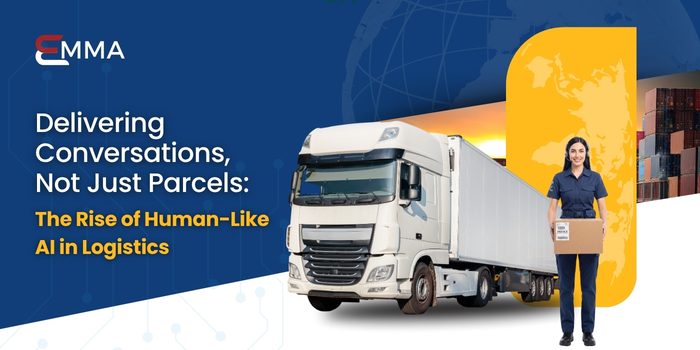
Delivering Conversations, Not Just Parcels: The Rise of Human-Like AI in Logistics
Your phone rings. Unknown number, out of state area code, the kind of call most people let go to voicemail on instinct. But something makes you pick up, and a warm, unhurried voice says your package hit a routing delay in Memphis, explains why in one sentence, and asks if tomorrow morning still works for delivery. No hold music. No “press one for tracking.” Just a conversation, the kind you’d have with a person who actually knows your order, except there was no person on the other end at all. This is where Emma lives now, built as a genuine ai voice agent for logistics rather than another automated menu wearing a friendlier voice. Customers rarely remember the tracking number on their package a week later. They remember how it felt to be told the truth about a delay, and logistics companies are only now catching on to that difference.
The Call Nobody Wanted to Make
Every logistics operation has a version of the same dreaded task: telling a customer something went wrong. A late shipment. A missed window. A redelivery that needs scheduling because nobody was home. For years, the honest answer to who makes that call was nobody, not really. It got buried in a queue, or handled by an IVR menu that made people repeat their tracking number three times before giving up entirely. Dispatchers knew the calls needed to happen and simply didn’t have enough hours in a shift to make them all, so the bad news usually sat unspoken until the customer found it themselves, in the worst possible way, at the worst possible time.
Voice AI for delivery notifications flips that dynamic entirely. Instead of a customer discovering a delay by refreshing a tracking page at midnight, the call goes out first, proactively, before the frustration even has a chance to build. That single shift, from reactive to proactive, changes how a customer experiences a problem. A delay handled with a heads-up feels like a minor inconvenience. The same delay discovered cold feels like being ignored.
Recovering the Deliveries Everyone Used to Write Off
Failed delivery recovery automation might be the least glamorous part of this whole shift and also the most financially significant. A missed delivery used to mean a returned parcel, a refund, an unhappy customer, and a warehouse eating the cost of a wasted trip. Now the call happens within minutes of the failed attempt: confirming a new time, correcting an address, asking whether the customer still even wants the item.
None of this requires a human dispatcher chasing down phone numbers between other tasks. The system notices the failure and responds immediately, at a scale no call center could staff for during a peak season without hiring dramatically more people than the margins can support.
Where Human-Like Actually Matters
Here’s the part most companies get wrong when they try this. Customers can tell within a sentence or two whether they’re talking to something that actually follows what they’re saying, or something reading off a script with slightly better production values than the last generation, and a robotic voice loses that trust almost instantly. Natural-sounding AI voice for customer calls matters for exactly this reason. Get it wrong and people hang up and dial a competitor. Get it right and they stay on the line long enough to actually solve the problem.
The technical difference is subtle but it shows up everywhere in the interaction: handling interruptions gracefully, picking up on tone, not steamrolling past a customer who’s clearly frustrated to get through a script. Emma was built around exactly this distinction, treating the actual conversation as the product rather than an obstacle standing between the system and closing the call quickly.
Tracking Without the Tracking Page
An ai voice agent for tracking shipments sounds like small convenience until you consider how many people still call in just to ask where something is, even with a tracking link sitting in their inbox. People trust a conversation more than a web page, particularly where something is different. The ability to ask “where’s my order from Tuesday” and get an accurate, instant answer, rather than having to hunt through an app for a tracking number half-remembered from an email, changes the relationship between a customer and a brand in ways a dashboard never could. This also removes one of the most repetitive burdens from a support line, freeing actual staff to handle calls that actually require a human’s judgment rather than a status lookup.
Coverage That Doesn’t Clock Out
24/7 customer support for logistics AI is most critical during the hours that no one wants to staff: the overnight shift, the holiday weekend, the sudden spike after a shipping delay makes national news. When you have conversational AI for last-mile delivery, that means every call is answered with the same patience and accuracy at 3 a.m. as it is at 3 p.m. A standard human teams were never realistically going to hit without burning out the people trying to hold that line.
The Bigger Pattern Behind the Disruption
AI supply chain delay notifications extend this same logic upstream, past the last mile and into the parts of the chain most customers never see A weather delay, a port slowdown, a customs hold all can trigger proactive outreach before the customer even realizes something is a miss. Getting that kind of visibility used to take an army of coordinators calling all day. Now it’s built into the system from the start.
Where This Leaves Logistics Brands
The companies pulling ahead aren’t the ones with the fastest trucks anymore. These are the ones that make their customers feel like someone is actually listening, even if that someone is an extremely well-constructed piece of software having what feels like a real conversation. That’s not something you can put on a spec sheet, but every customer experiences it on the phone, and it’s fast becoming the difference between a brand people trust and one they just put up with.
Emma is there to be the voice on that call, that turns a delay into a minor update rather than a broken promise. If your customers are still discovering problems on their own rather than hearing about them from you first, that’s a gap worth closing. Schedule a demo with Emma and hear what a genuinely human-like conversation sounds like when it’s built specifically for logistics.
Lorem ipsum dolor sit amet, consectetur adipiscing elit. Ut elit tellus, luctus nec ullamcorper mattis, pulvinar dapibus leo.